RSS

Author Archives: ReadWriteLib

Unknown's avatar

About ReadWriteLib

Metadata and ETD Coordinator at OhioLINK. UM SI grad. Loves librarianship, technology, and creativity. Enjoys cooking, traveling, reading, and knitting.

Cataloging and coding: more similarities than you might realize

I’ve talked about Code Academy before and it’s a great starting point if you don’t know how to code, or need a quick refresher. However, there is no pressure since it’s not a real project so my completion level is fairly low. I’ll do a lot sometimes when I’m really in the mood but normally I can find something more interesting or pressing to do–like blogging!

At ProQuest HQ, we have a really cool Library Volunteer Program set up that does Summer of Service with local libraries and school libraries. This spring, I joined the planning committee and got asked to update the internal wiki pages with HTML. My coding nerd was very happy indeed! Cleaning up and writing HTML code, what’s not to love! At the UMich Law Library, I worked a lot on HTML websites so it was returning to something very routine for me. Since the project had a deadline and a purpose, I poured my time and effort into making it not only look good for the users but tidying the backend code with the HTML viewer. (Now that I say this, I realize that I don’t use HTML view when doing my blogs. lol Not that I ever do anything complex for posts but that’s the next time to do–hack my WordPress blogs with my own code!)

Now, in the title I promised “cataloging and coding”, so here you are: let’s talk about similarities between them. Most obviously attention to detail, for coding that entails closing all the tags that you open and pairing them up correctly, while with cataloging it’s getting MARC indicators right and finding out things like the title proper and actual date of publication. Both are an art and a science–there are rules and standards yet flexibility and interpretation are encouraged and well used. Also, for the majority you work alone but still work with others from time to time, to engage, make decisions or work together on something. I’d also wager that both require being either tech savvy or tech willing; for cataloging it’s mainly software use and online research skills, while for coding it’s programming and probably online research skills as well. Also, both have robust Internet networks–usually ListServs for catalogers, and web forums for programmers/coders/developers.

However, there are many differences. Coding requires more technological knowledge, like knowing computer programming languages (and yes “languages” is appropriate because they are like foreign languages with their own vocab, rules, and patterns). Cataloging can be and is done by paraprofessionals without Master’s degrees; more complex stuff is done by professionals usually but now with vendors such as ProQuest (like me!) creating I-Level records, shelf-ready items that are fully cataloged are appealing to a lot of libraries these days. Also, coders and catalogers are generally two very different nerd types–geeks versus bookworms; happy hours might not be very fruitful between the two, one cares about the latest Doctor Who episode and the other cares about the 50 Shades of Grey kerfuffle in Florida. Okay that’s not entirely an accurate depiction but many people see those distinctions. Lastly, coding builds something, like a website or iPhone app, and cataloging records information for an item so it can be found. The purposes are very different as well as the end products.

But at the end of the day, I believe if you can do one that you’d be good at the other. Come on you coders, leave loftily FaceBook and come work for a library! Hee hee! Or if you are a cataloger, taking a programming or web coding course; you can always start on Code Academy!

For me, the future looks exciting and bright, with the possibility of cloud cataloging. What a perfect combo of coding and cataloging! Granted that like most ILSs, the code will only be viewed by the Systems Librarian but still I can dream.

P.S. GREAT NEWS! I’m attending ALA Annual in Anaheim after all! Woot! If you read my blog and will be there and want to meet up, drop me a line–or maybe I’ll bump into you at a cataloging or e-book session! If you do happen to sit next to be during a session, though, be warned, I’ll talk about MARC indicators, subject headings, and perhaps even the dreaded RDA. Plus, I’m signed up for a session entitled “Creating Library Linked Data: What Catalogers and Coders Can Build”! It looks so cool and I can’t wait (see, there’s that nerdy side again)! And to think, I planned this post before I knew I was going to ALA and found that killer event. Yea for serendipity!
 
Comments Off on Cataloging and coding: more similarities than you might realize

Posted by on June 7, 2012 in Uncategorized


Tags: , , , , ,

Emily’s Tech Talk Episode 2: Tweet, tweet!

Emily’s Tech Talk, episode 2: Twitter is what you make of it

Since I only worked three days last week, I didn’t see as many subject headings as I normally do and none stood out. So, time for another episode of Tech Talk, still making the rounds of social media. Enjoy!

This episode is just under 5 minutes but I cover a lot of ground. Do you like this length or the under 3 minutes better?

 
Comments Off on Emily’s Tech Talk Episode 2: Tweet, tweet!

Posted by on June 3, 2012 in Uncategorized


Tags: , , , , ,

New video blogging: Emily’s Tech Talk

The word vlog is just bizarre; I prefer video blog, though that’s still odd. (Now I’m thinking about subject headings–perhaps that will be next! I know there’s Internet videos…)

Anyway, my latest adventure, “Emily’s Tech Talk” goes live! I’ve posted the first episode on my YouTube page and figure that I will start out by walking through social media and its professional and personal uses, what I like and dislike. First up, Google+, which I’ve titled the episode for it “Google Minus” and explain in under 3 minutes why I don’t use it.

Did you like it? Comments, suggestions? I’ve got plans for a Twitter, Facebook, LinkedIn, and WordPress ones in mind. Anything else that you’d like to see covered? Perhaps I’ll do one on Code Academy!

Remember, these are only my opinions. 🙂

 
3 Comments

Posted by on May 30, 2012 in Uncategorized


Tags: , , , ,

There’s a subject heading for that!?: multiple confounding subject headings

Lately new subject headings kept to themselves, hidden away in other items in other people’s catalogs. I enjoy TASHFT!? posts (or is that acronym ridiculous, ha!) because sometimes they are more fun to discuss than cataloging issues since they are practical and get used each day, subject headings in general that is and not necessarily the ones I highlight in these posts.

But after stumbling, as we so often do, upon the third, I knew it was time for a post. All three start with the letter c and only offer brief discussion so they work well together.

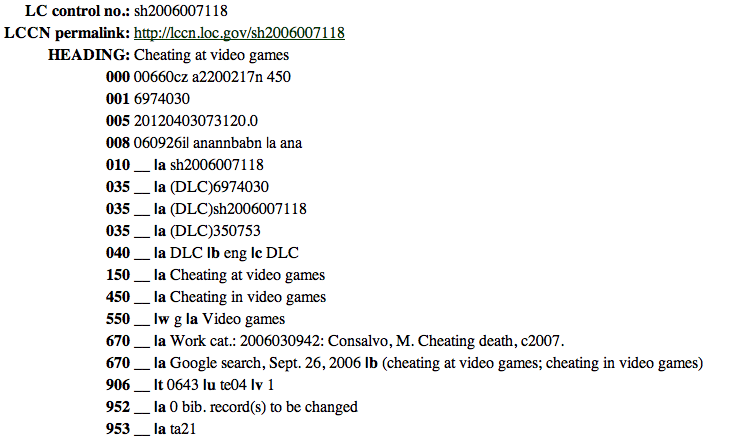
“Cheating at video games” caught my attention first. Now, before you or perhaps your kids get super excited about winning your favorite video games, just know that it only occurs twice in the LC catalog. Part of the issue with its low use is that game-specific guides are listed under that particular game. So, the Super Mario Bros. 3 guide that my friend had and used to get all the items and match up all the memory card rounds, is listed under that game rather than in this general LC classification that corresponds to this LCSH. Which is great for the users but begs why this was created, yes yes literary warrant but still I would have (almost) bet money that there were more books on this topic, and so did the person who set up the sub. head. in the first place. Yet, there isn’t a parallel one for computer games but maybe people only cheat at video games (which LC defines as television games, i.e. consoles). Or perhaps people just cheat rather than writing about cheating because if you can’t figure it out on your own or with the help of the internet than you don’t deserve to be able to cheat. Despite the straight-forward SAF, here’s a screenshot anyway, because it’s always fun to look at!:

Next up, “children’s paraphernalia”–gripping, isn’t it? It is if that’s the topic you’re cataloging! This is a sneaky sub. head. that looks vague but is actually specific, kinda. Let’s take a look and see why:

Alright, this is basically a broad term for children’s stuff. See, specific, sort of. To really cover the bases, there should be 450s for “children’s stuff” and “children’s things”, right? Since the item with this sub. head. dealt with making and assessing new products for kids, it fit well! Clearly, narrower terms are available and some are very specific if you continue down the nesting of some. Many of the narrower terms lead to items involving crafts for kid stuff, mainly knitted and crocheted blankets.

And finally, the third sub. head. that starts with a c, “cardsharping”. Huh? Comment if you recognize this term before I talk about it because I had no idea what they meant. Oh, Wikipedia, please explain! Thanks! Meaning card shark, got it. Wait, where is the cross-reference?:

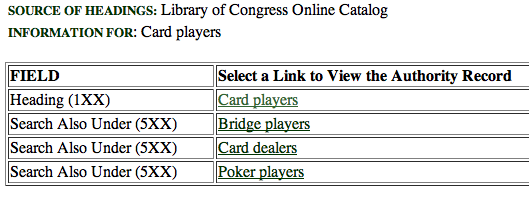
I guess no one says “card sharking” and this is meant for the action and not the people. In fact, there isn’t a sub. head. for card sharks or card sharps. While there is “card players” and some narrower terms, cheating card players aren’t represented:

As always with subject headings, you have to work with what’s there. Or propose/create your own if you’re able. Seriously, I might have to write a book about card sharks to justify literary warrant. Watching those cable professional poker marathons are fun during a hotel stay!

 
4 Comments

Posted by on May 21, 2012 in Uncategorized


Tags: , , , , ,

Famous!: At least among librarians and educators…who listen to the LiTTech podcast

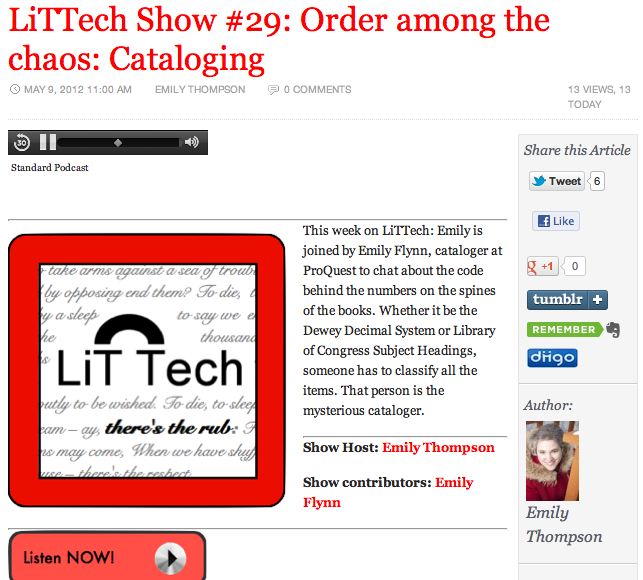
My awesome friend, Emily Thompson the Learning Technologies Librarian at SUNY Oswego, invited me to speak as a guest on her podcast, LitTech. I enjoyed explaining cataloging, touching on RDA and FRBR and the  future of cataloging. She includes great podcast notes with links.

Really, there’s not much more that I can say about it…please go listen, especially if you aren’t a cataloger or librarian.

So, want to hear the inside scoop about subject headings, get an explanation of cataloging, hear some library science history, or why paraprofessional jobs in cataloging are become more prevalent, listen to LiTTech show 29 and let me know what you think!

Enjoy!

image

Note: The above screen shot is only an image, so the listen now/play buttons won’t work; click the link above that says LiTTech 29! 🙂  (This will be obvious for most of my blog readers but my mom and family does read it, too!)

 
Comments Off on Famous!: At least among librarians and educators…who listen to the LiTTech podcast

Posted by on May 9, 2012 in Uncategorized


Tags: , , , , , , , ,

There’s a subject heading for that!?: night photography

Sometimes subject headings are cool and introduce a concept or topic that otherwise wouldn’t have crossed your mind. This week, “night photography” fit that case.

When I came across it, the sub. head. made sense but got me wondering why it needed separation from simply “photography” and all the narrow terms that go along with it. But as I looked into night photography further, the need for such a sub. head. easily made a case for itself, as seen in the linked examples near the end of this post.

First, let’s look at where this sub. head. is located. In the LC Authorities for “photography”, though there is a long list of narrower terms, you won’t find this one at first glance. Oddly enough, it’s nested within a narrower term. Can you guess which one? Spoiler: it’s under “available light photography”.

Available light photography covers the idea that only the natural light and the light already there is used when taking a photo, hence night photography listed as a narrower term of this concept. The authority for it is straight-forward:

Image

As the 680 explains, “night photography” covers “works on the technique of taking photographs outdoors at night and collections of these photographs”. While the description explains the concept simply, the photos and collections are anything but mundane. Have you opened a new tab yet to search for it? Regardless, here are some of my new favorite night photographers and their awesome night photos; for the photographer’s sake, I’ve linked to their works.

A graveyard with some streaking stars. Circus Krone in Augsburg, Germany. The Red Eyed Grouper, which uses some added light from flashlights for effect. 50 exposures needed for this beautiful streaking stars photo. A large collection of 60 night photographers. And finally, a more intimate gallery.

In addition to night photography in the pure sense, many photographers use flashlights to add mood, color, and dimension to their photos. One cool phenomenon seen in some of the photos is “light painting”, which can range from adding color to the Buick in the Red Eyed Grouper photo to actually creating another image in the photo via the flashlight such as orbs or shapes or even words.

Here’s an amazing collection of light photography that range from adding emphasis to the photo, outlining, and creating the main focus/subject from added light. LC doesn’t have a “light photography” sub. head. but since this occurs in night photography itself, one isn’t needed, not yet anyway. In the LC catalog, there are 63 works with the sub. head. “night photography” and a handful more with subdivisions. From what I can tell, there are no works explicitly on “light painting” by itself but it is addressed in some night photography items.

Here’s a more technical description about night photography and the light needed. Plus Wikipedia has a good article for starters.

While I am not a late-night person, these photos are so inspiring that I might take up this hobby myself! Who knows, maybe I’ll give up librarianship to become a night photographer.

On second thought, what cataloger could leave this wonderful world of subject headings?

 
Comments Off on There’s a subject heading for that!?: night photography

Posted by on May 6, 2012 in Uncategorized


Tags: , , , ,

MARC21 must die–according to one internet user

Aren’t life’s serendipitous moments amazing? I find it fascinating when things in my life suddenly collide. This time: cataloging and Code Academy.

First, have you heard of Code Academy? It’s a website that teaches people code in a simple yet robust manner in order to make the world more code/tech literate. Be warned, once you start it’s easy to get hooked! When I do get around to logging back in and coding again, I usually do a bunch of exercises in a sitting. The chunks are broken down really well so it’s easy to come back to and you do quite a few exercises in a whole lesson. More lessons are added to the site, especially since I started a couple of months ago and now it’s becoming a bigger website.

Today I sat down for the first time in a while and picked up the coding again. After I finally finished another segment (yes!), I stumbled upon an MARC21 lesson. In the description, the submitted says:

This is a project to build a short script to read a raw MARC record and display it in a more readable format. I hope that it gives cataloguing coders an idea of what a MARC21 record looks like under the hood and helps clarify the cataloguer’s opinions as to whether MARC must or mustn’t die. (HINT: it must). For more information about this project, MARC21, and a HTML version of the finished code, see http://www.aurochs.org/aurlog/2012/03/20/marc-viewer-codecademy-project/. However, do note that 1. This project was designed for someone who has done the first few weeks of the Code Year course. By necessity it introduces some new things and an attempt has been made to explain them and encourage the cataloguer to enter the actual lines of Javascript that make up the programme. In any case, the Hints always contain the correct code needed to proceed. 2. Output will often consist of many lines, so sometimes you will have to scroll up in the console to see what has happened. 3. Some lines (including line 1!) will always produce errors, although the script will still run. This is because MARC uses BAD and DANGEROUS characters. BAD and DANGEROUS characters are of course common in the world of cataloguing (mentioning no names…). #catcode @Orangeaurochs

Ha! The purpose of this lesson is to show catalogers just how ugly and messy MARC21 is and how it should be replaced already. I’m sure Orangeaurochs has to be an RDA supporter, since that too calls for a replacement for MARC21. On Twitter, I found his professional blog with a post that explains his Code Academy project a bit more–sweet! Also, he has more links to MARC21 information as well, for a more in-depth look, it seems. I haven’t been following the #catcode on Twitter but perhaps I will now, having gotten back into this once again.

I enjoy Code Academy and I hope you will try it out if you haven’t already. The website makes it learning code accessible to all, and there has been much refinement in the systems and interface that I’ve noticed over the months I’ve used it. Plus, the Q&A tab is very useful so check it out if the hints and tinkering still leave you stumped!

Code literacy–add that to your resume and job skills; it’s not too difficult, promise.

 
Comments Off on MARC21 must die–according to one internet user

Posted by on April 30, 2012 in Uncategorized


Tags: , , , , ,

Happy National Library Week!

This week was National Library Week. To celebrate, ProQuest offered free access to some of their most used databases and resources, along with giving away donations to libraries. Sweet deal, for sure!

My blog post proclaiming libraries were a stable necessity in society embraces the spirit of NLW. Twitter, blogs, and local library webpages have commemorated this week as well, encouraging people to use their libraries and enumerating how they celebrated this week.

However, next week Harvard Library Strategic Conversations will host a debate to determine if libraries are obsolete. Who knew we needed this debate? Although, some people must think that it’s about time. After my previous blog post, we all know which side I fall on–I’m just amused that I made my post last night before I saw the information about this debate. It should be good and I hope they post a full video afterwards! If you do visit the above site, the embedded clip there is from a 2007 debate and not the Harvard one, which is scheduled for April 18, 2012; if you are around there, you should go and listen then vote!

Libraries definitely need more attention and use, which essentially comes down to the librarians themselves and marketing plus providing wanted services. Many libraries already do a super job but it is now more than ever that we should all be much more vocal about libraries and their great offerings.

On that note, I’m learning to love RDA, a way to be vocal within libraries as catalogers. I blogged about looking past RDA not long ago, but having looked into it, while not perfect, it’s definitely an interesting turn for cataloging that could be spectacularly beneficial. An official member now of the RDA-L listserv, RDA issues will certainly be on my mind from here on. It’s exciting to be at the forefront of a new standard. Since I won’t be retiring any time soon, as the RDA joke goes, I’m ready to get acquainted for the start of what will likely be a long-lasting cataloger-cataloging standard relationship. Bring it on!

Also, if you didn’t catch my photo post earlier, I am a librarian with Pearle Vision glasses, thank you very much.

And show your libraries some love this week: stop in and say hi to the staff and use those resources and services! Happy National Library Week!

 
Comments Off on Happy National Library Week!

Posted by on April 12, 2012 in Uncategorized


Tags: , , , , ,

Image

Librarian glasses from Pearle Vision

Librarian glasses from Pearle Vision

Yes, I bought these glasses at Pearle Vision. Perfect for a librarian, wouldn’t you say? However, I mostly wear my contacts instead.

 
1 Comment

Posted by on April 12, 2012 in Uncategorized


Libraries as foundational necessities: a stable service for society

Today this thought hit me because it was trash day. I stood in the kitchen making my oatmeal when the garbage truck rumbled by, collecting the trash from each house on the block. Right then I thought, libraries are like garbage collection.

Garbage collection, same as mail and package delivery, is a service that will always have a place in American society. Going door to door to remove, or deliver, things needs to occur to keep our neighborhoods and society flowing. Though many communications are now digital and mobile, the Internet, I’ll wager, has increased package delivery since wonderful websites with let you chose and pay for items online but the goods still need to be physically brought to you. These services won’t go away, at least not in the foreseeable future.

Same with jails, churches, and public parks/swimming pools. All are physical spaces that service a societal need that cannot be replaced with a virtual system or interface. Some people need to be locked up for wrong doings. Many enjoy attending a location at the same time each week for spiritual and religious, as well as social, reasons. Not everyone lives in a place with a yard or a pool, so communal ones not only offer those possibilities to those who don’t have them but also act as another communal spaces to come together.

Like all of these services and places, libraries join the list. As librarians, we aren’t really the “gatekeepers” now that the Internet and online information are used by the public. But the physical space and responsibility remains. Even if all works in the future are “born digital”, physical books will remain and last as they have for centuries. In fact, if people only buy ebooks on devices, perhaps the library will be more valued with all the academic and pre-ebook works. While I’m not trying to describe a museum or archives, it seems my description has taken me there, though that’s not what I mean to imply. To the contrary, libraries are and will continue to be a hub for knowledge and advancement, a learning commons for individual and group work.

It’s really the librarians that make all of that possible: structuring the space, providing help and instruction, connecting people with information. Whether or not you believe reference is dead, people want to connect with other people, and need to, for the services that began this post. Anyone can and does search Google but who is there to help when the search isn’t turning up what’s desired? Librarians. Who puts on programming at libraries that include video game tournaments and teenage book clubs reading vampire novels? Librarians. Geeks don’t need to take over the library because they are already there! Librarians are on all social media and use technology–some more than others, but it’s an ever increasing trend. Why? Because libraries need to stay on top of these things to provide the best service to society as it grows and changes. As it’s been said, librarians usually lead the way when it comes to technology and online services. Plus, now with the current Pearle Vision sexy librarian commercial, patron use is bound to up-tick; alright the ad may use “naughty” and stereotype us with collecting late fees, but hey, if it brings more users in…

Regardless, libraries remain a foundational necessity and stable service to society no matter what comes our way.

 
3 Comments

Posted by on April 11, 2012 in Uncategorized


Tags: , , , ,