I recently purchased an iPad mini and have created a video review for those of you who are undecided about purchasing one or want to know more!
[youtube http://www.youtube.com/watch?v=7GlIJICm0uM]Category Archives: Uncategorized
There’s a subject heading for that!?: hurricanes
Of course there is a subject heading for “hurricanes”–just stick with me. For the past few days, especially yesterday and today, Hurricane Sandy is the topic of the media and many people’s conversations. It has surpassed the 2012 presidential election, for the time being, and that’s under a week off. In Michigan, we are seeing some of the effects as it is cold and very windy, though nothing compared to New York, New Jersey, and other states. Some Michiganders had snow this morning but only sleet was on my windshield and the rain here has been off and on. Hurricane Sandy, a.k.a. superstorm or frankenstorm, lost some of her gusto when she hits the Canadian cold front so now she is a post-tropical cyclone or, more colloquially, a nor’easter. However, before her name change, I looked up “hurricanes” on LC Online Catalog, since even though LC is closed, their website is still up!
Did you know that named hurricanes have their own subject headings? I don’t catalog works on hurricanes, so this was news to me. It makes perfect sense.

And the list goes on! This is only part was through the Ds, so check out the LC Authorities File Online to see the rest. Besides getting a scope of how many hurricanes are written about individually, the notes in the “hurricanes” authority record are priceless and fascinating–take a look below.

And a closer screenshot of the notes that describe hurricanes. Enough to be helpful in knowing what storms are termed hurricanes.

Sandy will likely get a narrower term under hurricanes as well, since she’s been, unfortunately, a massive and in some cases record-setting storm. Not to mention the fact that she way-laid the final week of political campaigns for Romney and Obama. However, her authority file will likely have a scope note that explains her changes in nomenclature, as well as references to her other names. Frankenstorm was the best, by far, considering her timing. This past Saturday at a Halloween party, one guest showed up in jeans and a tee wearing a name tag that read “Frank N. Storm”.
Another fairly recent hurricane that stands out is Hurricane Katrina. Searching subject headings in the LC Online Catalog, there are many topical sub. heads, and some that I never would have guessed. Here are a few of the ones that caught my eye: Hurricane Katrina, 2005–Computer network resources, Hurricane Katrina, 2005–Juvenile sound recordings, Hurricane Katrina, 2005–Prayers and devotions, Hurricane Katrina, 2005–Press coverage, Hurricane Katrina, 2005–Songs and music.
The single most interesting, for me, was Hurricane Katrina, 2005–Comic books, strips, etc. This is cataloging lingo for graphic novels, lately anyway.
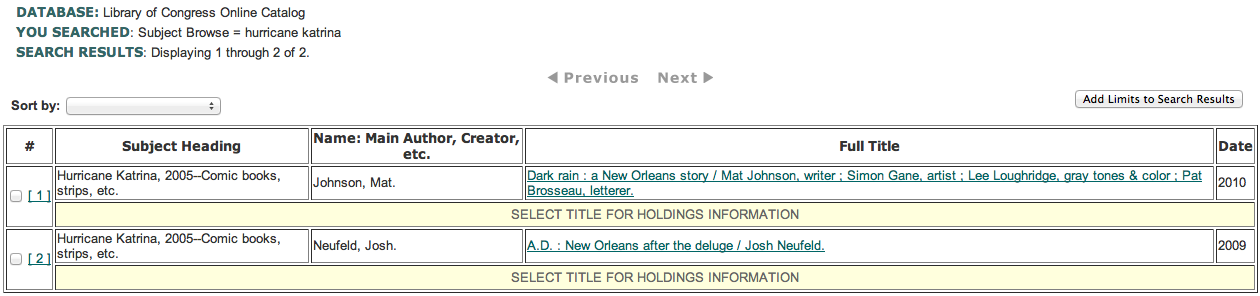
Graphic novels rooted in history can be amazing and present a different type of entry point into those events. Persepolis, and Maus are two of my favorite books, and I am not a reader of graphic novels. They both were assigned readings in college. So that makes me want to look up these two, particularly since I lived during the time of Hurricane Katrina. Perhaps they will make to it my bookshelf and onto my other blog as reviews.
For now, stay warm and safe, no matter where you live. And keep everyone affected by Sandy in your thoughts!
There’s NOT a subject heading for that!?: audio crossovers
Fall arrived today even if it is officially a few days off. What better than a chilly, dark, rainy day to get my blogs back up and running! (Readers of my book blog also experienced a hiatus–too nice of an August!)
Usually this segment covers subject headings that I found in the course of my work cataloging e-books and streaming videos. However, as catalogers, we also contend with fitting items into the best places possible when they lack a defined spot. Same goes for sub. heads that we cobble various ones together to represent the topic as best as we can. This was one of those times.
“Audio crossovers” is not a valid sub. head. in LCSH.
For cataloging The design of active crossovers by Douglas Self, I felt that there had to be more LCSH to consider for the record:

In LC’s Online Catalog (side note: their updated site was having too many problems so they revert back to the previous one and I’ve not had the issues that the new one experienced; it’s an awesome new design if they can get the bugs out!), the item only lists “Electric filters, Active $x Design and construction” for the one sub. head. And merely 7 other records have this same heading, though there are many more variants and lots with just the base heading.
Here’s the LC Authority File record for it:
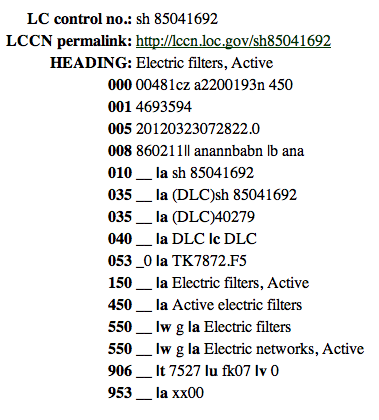
At first, this seems inadequate when it comes to the book’s topic. Using Wikipedia, we learn that an audio crossover is a type of electronic filter, so this is a slightly broader category. Yet, looking at the other 7 records in the LC Online Catalog with this exact sub. head., it is clear that those books focus on audio crossovers as well.
While it’s not perfect, it is the best LCSH offers right now. And considering all the variations for this sub. head., to propose a narrower term, or terms, then have someone parse out the items that should be in the boarder term and those into the narrower ones is a lot of work. Would it be worth it, probably, but I don’t know for sure.
The newness of the topic for this item was a challenge for me. That’s the other thing, for people, like me, who don’t know about a topic, the difficulty increases for cataloging it since I must figure out what the item is about then find sub. heads and a classification number.
Cataloging can be straight-forward or a balance between searching out and settling. The second makes for more interesting work but quite easily can lead to frustration or confusion.
Do you know about audio crossovers or electric filters?
There’s a subject heading for that!?: human engineering
Sometimes subject headings lead you astray, and for me, “human engineering” proved to be just that! At face value, I thought, sure must be related to cloning. Seemed odd that another sub. head. was needed to cover the topic, so I investigated–no surprise there.
Also, having asked another librarian friend his thoughts about the term, his initial impression suggested the it covered either 1) building robots or 2) developing humans. Both which get at a similar idea to my cloning relation, since all three hinge on the word “engineering” yet combine it with “human” in a specific scientific, almost sci-fi, sense for technologic advancement.
However, that is not the case at all. Which is why “human engineering” exists in addition to the sub. head. “cloning” or even “human cloning.” In fact, there are more records with the former sub. head. (932) than the later (60) and (20).
Enough suspense, here’s the reveal…this subject heading is about ergonomics for humans:

LC Authority File “human engineering” subject heading screenshot
The 550s, see also notes, suggest looking up “human comfort” and “human-robot interaction” as well for related items and topics. The 680 helps explain the sub. head. very well compared to some records: “here are entered works on engineering design with reference to man’s anatomical, physiological, and psychological capabilities and limitations.” Even without this scope note, the record would convey the meaning of this sub. head. anyway because of the other terms and fields it contains.
While it’s a great LC Authority FIle record, this just goes to show that a subject heading isn’t always what it appears to be at first glance. Regardless of whether a heading is new or well-used by use as a cataloger, my suggestion is to take the extra few seconds to check the authority file and make sure the meaning in your mind is the one that LC means as well. You may be spot on, or in this case like myself you may learn something new!
ALA Wrap-Up: About Time!
I feel the need to post some sort of wrap-up for ALA Annual in Anaheim, though tomorrow marks two weeks since I returned home from the conference. Already? Missed New Orleans but went to D.C. and made it last minute to Anaheim; each time that I attend Annual, I love it and keep learning each year how to get the most out of the conference. So without further ado, here’s the
Top 5 Ways to Get the Most from ALA Annual:
1) Go with a plan of what you want to attend and when. Simple but effective. Annual is overwhelming and even the paper program (who knows how much longer they will actually print those) is a lot to page through itself. Online, ALA had a cool Scheduler for the conference that allowed searching keywords and other things to find just what you are interested in and hone in on what you want to attend. I’m not one to go to the Exhibition Hall. In D.C., I was a grad student who wasn’t SLM or into YA so I perceived the Hall for merely grabbing kids/youth books or talking to vendors to work out deals for your libraries. This year, being from a vendor but attending on my own and not helping with the booth, I still felt the Hall wasn’t for me since I don’t currently work for a library and have buying power, and I still don’t need to pick up kids/youth books or graphic novels for my students/library. But I walked the floor and the author and illustrator signed books literally handed to me, I gave to my School Librarian friend for her library and students. Lastly, looking ahead at what was offered, I paid for the all-day workshop on linked data Friday so when I signed in, I knew at least what I for sure was attending first and it jump started my whole ALA because the workshop immersed me and allowed me to meet so many cool catalogers and coders and make new connections besides learning a lot and hearing about what some believe is the future for cataloging as well as the Internet.
2) Be flexible with your plan. The variety and options conferences offer truly make it a fun time. While you go with an idea of what you want to attend and do each day, allowing for change can give you the best experience. Once at the conference, I went to the first couple of sessions then decided to look through the program to see what else was offered. The workshop and session for linked data was very similar and it hit me that it’d be more valuable for me to attend sessions that would teach me something that I didn’t know and different topics would help with that. If you read my previous posts from ALA, or chose to go back now and read them 🙂 , you’ll see that I switched up my plan and went to a publishing, responsive web design, and learning styles session that each expanded me knowledge in library areas that are not usually my preference. I like seeing the library as a whole and understanding each part and aspect to know how they all work together.
3) Serendipity chooses you but you also choose it. Attended a session and hearing something that clicks an idea into place or gives you inspiration provides one way of looking at serendipity. Sitting next to the right person and being asked to talk to your neighbor to discussion a session topic initiates another side of serendipity (like my experience at the learning styles session). But I learned that serendipity is created as well; especially at a conference, people are chatty! Talk to anyone and everyone because you never know who people are or what they know or if you can help each other out. I met Nancy Pearl just by being friendly and introducing myself. I offered help and encouraged someone to e-mail me after the conference concerning the Safari product that I work on for ProQuest. Also, I met a Safari user, and a volleyball dad their for the tournament, in line at Starbucks and we both learned things from each other about the product and using it–I tweeted on June 24 that I catalog for him because I do think of the end user and what will best help them find this item and know exactly what it’s about. If a conversation is just small talk that’s fine but you never know when you might really help someone out by being open and friendly, such as when I explained cataloging and why MARC records are important to a small publisher who attended ALA and a metadata session to learn more. That was a favorite part of the whole conference for me and made the trip and costs worth it. Make the conference work for you while enjoying the ride as well! For more stories, read my other ALA posts. The point of a conference is to meet people so introduce yourself to others and especially panelists!
4) Take notes and write down what you learned at sessions and every evening. Though tired and wanting to hang out with colleagues, friends, and my librarian husband every night when the conference doors closed for the night, I made sure to post a summary of my day each evening to my blog before bed. It kept me thinking about what I attended and why, and if something didn’t work out well or I didn’t particularly enjoy something as much as I thought I would, it allowed me to be flexible for the next day and spurred me to page through the program to find more sessions that I would enjoy or learn about something that I could apply to my work or career. Writing notes and thoughts during sessions and workshops helps me make connections and remember things better. I hauled my computer along every day and could have just typed but I find that more distracting than just pen and paper, yet it turned useful when some sessions become interactive–such as the responsive web design one, and then it’s nice to pull slides or websites or code up on your computer in tandem.
5) Get involved. ALA is much more than just a professional organization run by a single board. Many committees and subcommittees make up ALA and offer tons of opportunities to get involved if you want. Most of the sessions are put together by these committees and subcommittees and even their meetings can include panels and talks about topics related to the group so it’s worth looking those over and attending them as well; as one person at ALA told me, unless the session/event/meeting is marked “closed”, anyone at ALA can attend it. Besides helping out with ALA itself, there are other ways to get involved such as finding out from editors and library journals if they have publishing opportunities. Also, there are related groups such as Spectrum Scholars and Emerging Leaders, and more. Prior to ALA Anaheim, I responded to a call for volunteers for an ALCTS subcommittee and can proudly say that I accepted the two-year position of Co-Vice Chair 2012-2013 followed by Co-Chair 2013-2014 for the Cataloging Norms Interest Group! This means I’m attending Mid-Winter and Annual for the next two years (four conferences!) to serve on the subcommittee and help plan their meetings and conference sessions. I can’t wait to be involved and see where this leads me next!
Finally, take 10 minutes and listen to the super awesome “Live from ALA Annual 2012” LiTTech episode #36 by Learning Technologies Librarian, and grad school friend of mine, Emily Thompson. The brief episode takes live audio clips that Emily got from ALA attendees–including a few famous authors who talk about the importance of libraries and the ALA conference. Definitely worth the listen, and check out the show notes to see who everyone is! I’m in there twice, once talking excitedly about my blog stats during the conference–I tweet and handed out lots of personal business cards with my blog and Twitter handle listed on them–and another time as the person who Addie tells the fire alarm story too–where you around for that? I think I was getting lunch then and missed the exodus of librarians from the conference center; listen to find out what cause it! Also, Emily and Addie have another episode up that’s there wrap-up from ALA, so at least I’m not the only one who’s had a lapse in posting it. I’ll listen to it tomorrow at work, since I have a well-deserved, and needed, day off today. Again, lesson number 4, write notes and blog that same day; this post was supposed to get done on the plane ride back and be up when I got home to my Internet but time can get away especially when you are recovering from at very packed five days of busy conference going, followed by trying to return to your normal work routine while still jazzed from all the cool people, sessions, and ideas from ALA Annual.
Hoped this helped and you picked up some great tips! I’m sure I’ll learn more tips and tricks when I attend Mid-Winter this year while getting involved. I’ve never been to Seattle and cannot wait! See you there? Or find me in Chicago next summer!
ALA Anaheim: Manic Monday
The title for this post is meant in a good way–as all days at ALA Annual, it’s always busy and full of good stuff and great people to meet. Although many seem to be taking off day. For me, the conference really is a marathon as I’ve done all day Friday through Monday and fly out tomorrow mid-morning; though I don’t sleep on planes, there is no way that I will stay awake for that 4+ hours flight, which I need/have definitely earned!
My plan of three sessions today turned into two due to cancellation which gave me an extra long and well-enjoyed break since I’ll be meeting with friends for coffee and catching up later this afternoon and hopefully getting free tickets to The Perks of Being a Wallflower, an advanced showing tonight!
Session 1) Publisher/Vendor/Library Relations Interest Group had a panel of speakers made up of a representatives from Springer and Project MUSE, plus a couple of librarians (a cataloger and admin who used to be a cataloger) from the University of Minnesota (Go Gophers!). Being in another building likely kept the numbers down, plus being on Monday but it was still well-attended considering, with around 30 people there at 8 a.m. this morning. Since both are more publishers than vendors, it was interesting to hear about what they do to create their MARC records–usually machine generated initially then outsourced to OCLC/SLA for cataloging enhancements before going to the libraries with the e-books. The librarians obviously addressed the growing difficulty and frustration with editing and tweaking batch records that have various quality and consistency issues not only across multiple vendors but within a single vendor some times. Thankfully, the publishers said that they gather and want feedback for providing what libraries want. And the librarians, thankfully, called for action and accountability among libraries in order to share information and band together to approach vendors and publishers with their needs and demands for better MARC records as budgets, staffing, and work loads change rapidly. During the Q&A I did speak up and mention our (apparently special) department of full-time catalogers and that we do I-level records; I take it for granted because that’s where I work and my environment so it was shocking (but shouldn’t have been) to hear fro the panelists. Also, I piggybacked off of the comments about collaboration on everyone’s part to get better MARC from vendors and publishers and encouraged libraries to work together and approach them with their desires and needs. Another cataloger mentioned the BATCH List listserv that shares valuable information about record changes that are useful for all libraries.
Lesson learned: Vendors and publishers can and will provide better MARCs if it means more business for them by giving libraries what they need in an economically tight time for everyone. Just ask! We all are in it for the end users so why not collaborate and make metadata better, which is now more important than ever for discovery.
Session 2) CANCELLED Seeing is Believing: Understanding Data Visualization for Library Research didn’t end up happening but sounded very practical and would have been useful. But I won’t complain about having a longer break before my afternoon session, although now the tiredness is setting in the more I sit still and am left to my own devices rather than being stimulated by a session. Nap or upcoming session? Onto session 3 for the day, just because it will be cool and has great speakers! Sleep is for the plane tomorrow.
Lesson learned: Maybe 3 sessions plus other activities, the exhibit hall, and networking is too much. But I’m still plugging along and fitting everything in that I can to really squeeze the most out of ALA while I can!
Session 3) Riding the Publishing Roller Coaster: Practical Strategies from Research to Writing addressed the writing process through getting published. The panel had both authors and editors (who were also authors!) that gave great, practical tips and advice. It’s always refreshing to hear others talk about all the hard work and difficulty and challenges that go into writing and publishing. Too much to share but if you are interested in learning more, I could do a longer post delving into what was said. Most was common sense but needed reminding; I nodded a lot during the session, if that puts it into perspective. They all articulated their advice and tips eloquently.
Lesson learned: Reminded that writing is hard work so be humbled and respectful of your self and other’s works. Put yourself out there and be flexible when need to yet stick to your convictions but be able to explain why if you really don’t want a particular change made to your work.
After the last session, I meet up for coffee with UMich grad school friends and one of our professors to catch up! Soon after, we headed to get tickets for the advanced showing of The Perks of Being a Wallflower! Amazing movie with Emma Watson, by the way. How did I miss this book growing up? However, after the film, everyone got a free copy of the book and the author was there for q and a and book signing! It was a fun evening with good friends–a great way to wrap up ALA Annual!
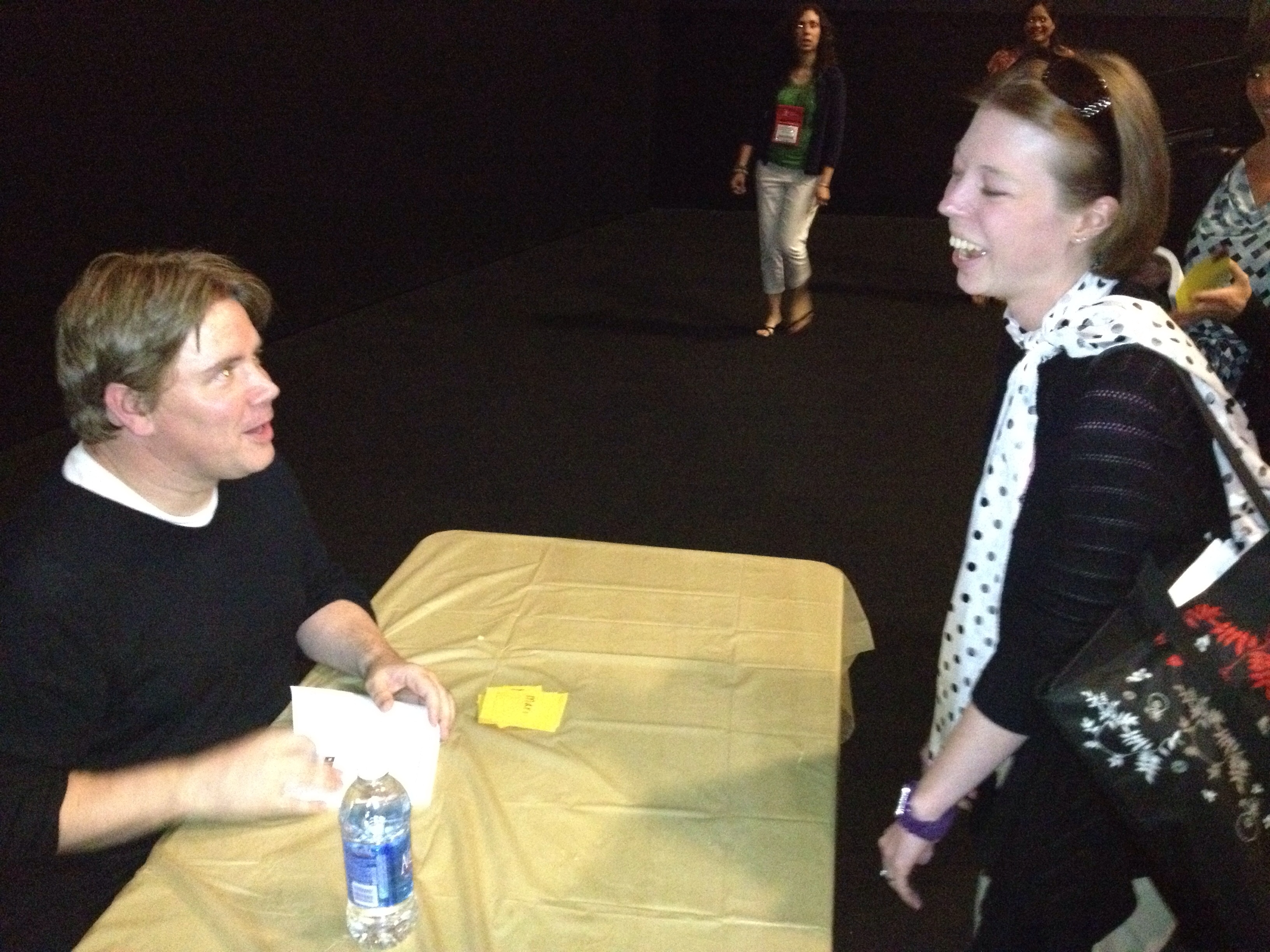


Go see the movie when it comes out and read the book until this! My new favorite movie!
Look for a post tomorrow, likely while at the airport, about tips and advice about attending ALA and what to do now that we are all still a buzz from the great sessions and people here. My friend and classmate, now Learning Technologies Librarian, Emily Thompson hosts a podcast called LiTTech with another friend/classmate now School Librarian, Addie Matteson that address libraries, education, and technology. Not too long ago, I spoke as a guest about cataloging with Emily, which is also available for download on iTunes as well. They were here at ALA collecting sound bites for their next upcoming podcast, so keep an eye out for that; I’ve heard some bits already and it’ll be great and fun to listen to!
ALA Anaheim: Stuffed Sunday
Appropriate title but also reminiscent of a subject heading that I discussed months ago!
Today, again, was jam-packed with sessions but that’s the general point of conferences. Three is the magic number for me because that’s about all I can max out for intact of information.
Session 1) ebrary: Strategic E-book Acquisition for Academic Libraries provided a breakfast before their talk about PDAs (patron driven acquisitions) with actual libraries to tell their stories and experiences. Hearing from others attending, it’s the best conference food, and it was good. Even though ebrary is a part of ProQuest, hearing the concerns for librarians in the room as well as their wonderful stories. Plus, several higher ups from PQ also attended, including CEO Kurt Sanford. As of right now, apparently choosing the short-term loan option has a fee that doesn’t go then towards the purchase of the book later so some of the libraries just select the PDA option. Maybe this will change in the future. Feedback is always taken to heart at ProQuest, from experience, but not always acted on.
Lesson learned: Sessions with food are well-attended and it’s great when presentations by vendors that address topics rather than just a product pitch are much more interesting and useful.
Session 2) Responsive web design: get beyond the myth of the mobile web showed just how easy and necessary it is to make library websites that adjust to the size of the device accessing them. The cool thing about this is that it’s one website with extra code that has different tweaks based on the screen size of the device, using percentages instead of pixel widths. The example website is LOL Library by presenter Matthew Reidsma that as you view it on a computer browser, resizing it will show you all the variations, the rearranging of the same content for all the different devices. He’ll put everything up online, including the code at GitHub for the LOL Library website.
Lesson learned: Everyone needs to do a single website that is built with responsive web design. There are lots of resources on the web and Matthew posted his slides and presentation so when you have time, watch it and make use of it!
Session 3) Learning Styles: Fiction, Nonfiction, Mystery? taught me all about what learning styles are and how to use them in instruction–there are 21 different types so it varies greatly. The three panelists were wonderful and it was more informative than practical which for me was perfect since I was new to the idea coming in. Oddly enough, there was a turn-and-talk discussion with the people next to us, and since I don’t teach or do instruction, I listened a lot to my neighbor and spoke of my husband Steve’s stories of his teaching that he’s shared with me; the librarian I spoke with was very skeptical about the presented information and told me about what his alternative views are on what’s important and affects instruction to make it more meaningful and useful for students. Lots of food for thought!
Lesson learned: Though people are presenting on a topic, sometimes it’s good to be a skeptic and think about different ways to approach the issue and other creative solutions. Plus, my discussion partner mentioned What best college teachers do as a great practical book–so look into it if this is important to your work!
Exhibit Hall for some is the essence of the conference but for me I avoid it. One, lots and lots of people make it overwhelming. Yet what it really comes down to is that I don’t need or want to collect books, plus I have no scope for talking to vendors or other companies that provide equipment and software to libraries. It’s weird working for ProQuest in that sense but it also means that I don’t have to wait in lines for book signings or pack/ship tons of books home. During some down time between sessions, I did wander though out the whole hall during a fairly quiet time, so I literally got handed books that got immediately singed by the authors and illustrators. Thank goodness my friend Addie is a school librarian and happily took the handful that I collected. I did get registered for a chance to win two Kindles, and finally found the booth giving out free Brave tickets.

Dinner with friends and then watching Brave for free in a theater full of librarians was the highlight of the day, though. Seriously, it’s a great family movie and a really fun daughter/mother adventure so ladies go with your moms!
Tomorrow morning begins at 8 a.m. yet again–what is with such early morning sessions? Start early, end early to give people an evening for other stuff, I guess! Full plate yet again. How about you?
ALA Anaheim: Super Saturday
Very busy day today! Lots of wonderful sessions which makes it hard to decide what to attend. In the end, the three sessions I chose today taught me a lot and were enjoyable.
Session 1) LITA’s Linked Data and Next Generation Catalogs covered a broad base of what Linked Data is, why libraries should lead the charge, and how to do so. Different libraries and vendors on the panel talked about the topic generally while also delving into specifics of projects and current use of Linked Data. Unfortunately, attending the all-day Linked Data workshop yesterday at the pre-conference meant that some of the speakers also presented at this event as well and while they weren’t the same presentations, there was overlap. But being new to Linked Data, it was good to have things reiterated and spoken about more broadly. A few others from yesterday came as well but doing one or the other would have been sufficient, especially since this session lasted 4 hours and covered lots of ground.
Lesson learned: Instead of trying to hit all the same topics, vary your sessions to learn more and expand your horizons–plus you have the chance to meet so many more people of all different types.
Session 2) Transforming Technical Services: Growing IT Skill Sets Within Technical Services Departments provided a practical realistic look at how to increase tech savvy among TS staff. Several libraries each gave their take on what it takes to increase, encourage, and support professional development in application development, software training, and bringing more tech into library work to ensure projects are done by librarians who understand the system, users, and needs rather than hand it off to already busy IT people. Oddly enough, all the speakers rounded back on the same or similar tips and concerns but each offered their own way of how they handled their situation and what their solutions and realizations were. So useful. And not just for TS–this applies to libraries in general as well as general business. In a nutshell, talk the the staff to find out what they use and need but remember that they don’t know what they don’t know at time, encourage and support relevant learning that will make their work easier and more effective, start with small and meaningful projects that are achievable and leave a lasting impact to increase buy-in, and work within the knowledge and abilities of the staff to drawn on the best of what they can offer pairing it with the technology to increase their effectiveness.
Lesson learned: Though libraries are becoming more techie and librarians with tech savvy skills are needed and necessary these days, as one speaker said “Remember, we are not growing programmers”.
Session 3) Traveling the Spectrum: From Interstellar Adventures to Epic Fantasy, the influence of Science Fiction and Fantasy on the World Today (i.e. the George R.R. Martin talk!) was my guilty pleasure session of the day and a great way to relax and enjoy a fun author-talk. Besides George R.R. Martin, Blake Charlton also spoke and, for some reason, Lois McMaster Bujold wasn’t billed but was on the panel as well. Each talked about themselves, their paths to reading and writing books, and how Sci-Fi and Fantasy shaped them and the world. Though I’ve not read a word by any of these authors (I LOVE the HBO Game of Thones show), they are now three of my favorite authors and I vow to read their works as soon as my year of reading my bookshelf is up, which isn’t going so well this month, lol. Each was so humble and had tough lives that lead them to not only books that engaged and inspired them to read and eventually to write. Authors that talk realistically about writing and what it took to get their win me over instantly because, like most things, book writing is not magic and neither is getting published. Hard work and persistence win out. Once I finish Camp this June, I might be crazy enough to write another 50,000 words in August for it again and this time return to my roots of Fantasy and Sci-Fi as well; it’s been a decade since I began my Fantasy novel that never really got off the ground but after this talk today, I’m ready to commit a month to returning to those worlds and characters and actually writing the novel now.
Lesson learned: Listening to them all made me realize that fantastical literature/fiction is escapist for a reason; most Fantasy and Sci-Fi authors and readers lead hard lives, in one aspect or another, and the release and travels and adventures that those genres provide enrich everyone’s life who writes or reads them. And as with most genres, there is quality and fluff so there is something for all tastes and preferences and if you haven’t read any, find out about them (use Reader’s Advisory at your library) and crack open some books and see what they are all about!
Now, time to briefly look over my schedule tomorrow to set a game plan for more sessions! Are you ready for yours?
ALA Anaheim: Pre-conference and kick-off!
Even though #ALA12 officially began with the Opening General Session at 4 this afternoon, I arrived late last night in order to attend a pre-conference session about Linked Data. Being an all-day session, it was jam-packed with great presenters, attenders, and information. The Twitter hash tag was #ala2012_ldpre and many of us tweeted during it, so definitely check it out if you’re interested in seeing how the day progressed.
The format helped keep the momentum going for the entire day: a key note, lightning talks, small group discussions, and reporting back to the whole group. Though the session focused on Linked Data, a whole range of aspects and depths were discussed. From theory to how to get started, global implications to SPARQL queries.
The presenters represented vendors, libraries, and even LC. Each honed in on a different part of the Linked Data topic and yet the talks fit together well because it built a larger tapestry of the topic and issues surrounding it. The fun part was hearing and seeing examples of how LD could advance libraries but also the web more generally. Yet there are many problems and concerns that get in the way, mainly time and money. However, as the keynote speaker Eric Miller pointed out, catalogers and libraries are particularly well poised to lead the way to make use of LD and have been doing so for 40 years with MARC already: think controlled subject headings and names. All controlled fields and the accompanying authority files are Linked Data.
My brain still buzzes with all the new information and ideas and hope for the future. Cataloging is changing quite rapidly with FRBR and RDA, and now Linked Data. Yet it isn’t changing, really. The theory and the purpose are the same but now technologies are advancing to allow us to create things that were never possible before. For some it’s a scary unknown but it could bring libraries back into the conversation more if we helped create and guide standards that would organize and maintain data on the web as well as in libraries.
Several people at this session today called for action. Not just holding meetings and being aware of what’s going on with Linked Data but actually creating and doing something to test and set up projects to find out what best works and begin stepping into the future today. How apt a statement with Disneyland across from my hotel. 🙂 But, as was reiterated as the day’s session wound down, there is no magic involved–it’s all hard work by smart and dedicated people working together to build off each other to make some. So let’s create Linked Data and help build better libraries and a better world with excellent data! Who’s with me?
 ReadWriteLib - Emily Alinder Flynn