Metadata and ETD Coordinator at OhioLINK. UM SI grad. Loves librarianship, technology, and creativity. Enjoys cooking, traveling, reading, and knitting.
The Midwest went directly from a mild winter to a pleasant summer! The weather is great, even though it is abnormal. But sugar maple trees aren’t running, meaning no maple syrup this year–very sad indeed, except for the fact that we still have one unopened jar of my dad’s homemade syrup from a previous year still safely tucked in the pantry; if syrup times get really desperate, I might put it up for bids on eBay in the fall and of course provide you lucky readers the link! 🙂
While enjoying this beautiful weather on the porch in Ann Arbor, and some times the balcony in Wooster, I found an interesting heading that conveys much with just its name: ecofeminism. This came up during a search for environmental topics and though it wasn’t needed for any of my items, this sub. head. really intrigued me.
With its name, it invokes women, feminism, ecology, nature, the environment, and saving the planet. Could there be a more perfect term for Mother Nature? Very apt. There is a Wikipedia page that explains the basics of the movement.
Here’s the LC Authority File for ecofeminism (with a 953 cut off by the screenshot):
The 680 really says it all! This seems to be a really dynamic and fruitful subject heading for a precise topic. Yea! It’s always fun to find these types. I love it when a sub. head. is summed up in itself and conveys exactly what it is about.
“Ecofeminism” reminds me of Julia Butterfly Hill’s book The Legacy of Luna about her time spent sitting in a tall redwood nicknamed Luna in order to prevent loggers from cutting it down. The story is wonderful, if you haven’t read it. However, this one does not work as a sub. head. for that book but I made the connection because of the Search Also for it:
In the LC catalog, there are currently 94 items with the sub. head. “ecofeminism,” and several more with further qualifiers, mostly locations, if you too have become interested in this topic.
Now, to put down my laptop, slide on my sunglasses, and retreat to the porch with a book! Hope that you are enjoying the marvelous weather, too–unless you happen to be in the West, which I hear is chilly this year.
Tele-what? Yes, “telematics” is the subject heading of inquiry this week.
When I stumbled across this one the other day, like Link opening a dungeon treasure chest, I knew it was exactly what I needed to finish my record, which is oddly similar to finishing a level in Zelda–on a quest to find those perfect subject headings and gather all the information needed to complete the record.
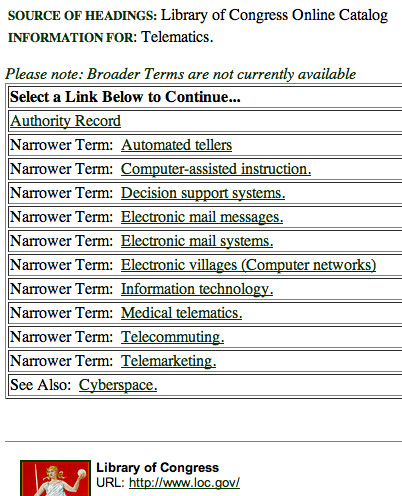
Here’s a screenshot of the LC Authority File for “telematics”:
Basically, “telematics” encompasses the use of computers for communication and the exchange of information. The book in hand at the time dealt with computer use in classes (i.e. computer-assisted instruction), email, blogs, SMS, and other information technology in education. While “internet in education” and “telecommunication in education” provide a good base, “telematics” helped bring out more detail as to what the book was about. There are 61 items in the LC catalog with the plain subject heading and many more with geographical subdivisions. And even some with the “law and legislation” subdivision that sound intriguing.
Cataloging involves lots of learning and demands curiosity and questioning in order to ensure that the most accurate and best sub. head. are used for an item. The book’s title involved the phrase “computer-mediated communication” which to me sounded like jargon so I didn’t search it in the authority file. Instead, my browsing the LC catalog allowed me to find “telematics” and discover that “computer-mediated communication” is a 450 for “telematics”!
However, this is another sub. head. that feels like it was made for librarians by fellow librarians. What patron would ever type “telematics” in the catalog or even know to click on it in a record? Do people really know what it means when they see it? I didn’t. Perhaps that is where the reference librarians enter the picture, in one aspect, to navigate the catalog and its records in order to help patrons find just what they are looking for and other related items of interest, too.
Even though catalogers hand-pick subject headings, it would be much more helpful to have headings that make sense even to us from first glance. Many already are self-explanitory but in cases such as “telematics”, clarity could improve not only the subject heading but also it’s use. But at the end of the day, we have to make do the best we can with what we have. I was just glad to find that 450 in “telematics”.
Nothing too exciting has crossed my virtual desk lately. Pretty standard stuff with subject headings that I’ve seen before, or just don’t call for any extended pause. One interesting item was title 50 jobs in 50 states in which the author traveled around the country in 50 weeks to work in every state, as a way of doing something productive with his life after not being able to land a full-time job after college. But the sub. heads weren’t earth-shattering.
I did notice an oddity with sub. heads–everything is plural. Delimiter x examinations. Delimiter v study guides, etc. Though there are exceptions such as web site development, yet it cousin is web sites. But that’s not nearly enough to write a whole post on!
How does one explain cataloging to a non-cataloger?
When I introduce myself to non-libraians, I say that I am a catalog librarian but continue on to explain that what I create is the information you see when you search a library catalog, the record with the title and author and description of the item. Sure, this is pretty basic and perhaps still not helpful enough for some people. Maybe after hearing “librarian”, they have already tuned out anyway, or just think of people checking books out and sitting at a reference desk staring at a computer screen.
But that doesn’t get at my question still about what is cataloging.
This weekend my reference librarian husband asked me what AACR2, MARC21, and subject headings were and how they work together. Being the Emerging Technologies Librarian, he’s tech-savvy and has looked at many catalog records while helping students and faculty but he didn’t take a cataloging course nor has worked with MARC records himself. Really, he was asking about their purpose. My first instinct, for some reason, was to compare them to cars.
Cataloging is like a car. AACR2 is the idea, the concept, the form (thanks, Plato!); a car has wheels, doors, a body, a steering wheel, and so on. In general, most cars look similar because the hood goes in front, the trunk in back, wheels on the sides, a roof on top. There are choices: engines can go in front or in back, doors can be two or four or lift vertically, side airbags are optional but becoming more prevalent. AACR2 assumes certain things in a record such as main entry, statement of responsibility, and publication information. Main entry varies depending on the item, as title or author. Authors can also be added entries instead of main. But all in all, the content that goes into a record is similar to parts that make up a car.
Next, MARC21 is the details, the execution, the item itself. Car types vary but each make and model is arranged a particular way. The exterior color, the interior material, the dashboard knobs and buttons, the hub caps all form an individual item. A car can be embellished with dealer extras and upgrades, or bumper sticker, a new paint job, or even damage from an accident that make the car more unique and distinctive. Though it has a multitude of details, each person sees different aspects of that particular car; someone might notice the scratch on the door, the customized flames on the hood, or size and shape of the headlights. MARC21 holds the details of an item, whether there is a cover title that differs from the title page, a series title, or if a disc is missing. These basic and distinctive aspects of an item truly describe it and its nature. However, I might catalog it differently from someone else, which is where variation arises; someone may add a 500 note to include added information, others might decide that the classification should be different for their collection and library. Though MARC21 contains the item’s description and details, each cataloger chooses what to represent and how.
Subject headings group related items through the ideas, concepts, people, and places they represent. Cars are described in many ways: by color, size, type, purpose, shape, brand, and on. Each description can change just what is being talked about: blue cars, SUVs, supercars, cars that look like cubes, Fords. A car will have numerous descriptors, some that are more distinctive that others. Subject headings are the same. I catalog a book about how to use the iPhone and choose to use a sub. head for iPhone and smartphones and mobile computing. But another book about iPhone app development requires tweaking those sub. heads and adding more such as application software delimiter x development, and bringing out the programming aspects of the other sub. heads with a delimiter x. Though they are related items, they get different terms, some similar and some not.
This version is extended from the version I gave Steve but the gist is the same. When I asked him if it helped, he said no. Maybe the life of a cataloger is only understood by other catalogers. What do you think? Does this example work? Is there a better one?
Addition (July 11, 2012): RDA will replace AACR2, though for not it will live along side. RDA is a different set of rules and guidelines for building the same general thing: a record for an item. From my understanding, FRBR could also fit under what AACR2 currently covers as well; it works in tandem with RDA to help shape a record for an item and the relations of information within it. Yet FRBR doesn’t provide much in the way of strict rules and decisions–it’s the big picture whereas RDA digs down a bit deeper. FRBR could be the car brochure while RDA is the car manual. And now with linked data in the picture as well, MARC records may be more versatile than ever, able to switch and swap out information as need for the users, and truly trick out records to become resources. See my ALA Annual post on the all-day workshop or the general overview session for more about linked data and cataloging.
P.S. We love Top Gear, hope you enjoy the clip! I’ll have to be more than a cataloger if I every really want to own a Zonda.
Since RDA has yet to be implemented, this might sound presumptuous but I’ll throw caution into the wind and just say it: we should move past RDA to a post-RDA cataloging world.
This is an idea I’ve been kicking around for several months, having cataloged professionally at ProQuest now for soon-to-be 7 months! Jan. 5th came and went quicker than the 6 month acknowledgment allowed–kinda like those linger holiday thank-yous that I swear Steve and I will write this weekend. Being a professional, rather than a student, cataloging is fully on my mind all the time now.
What we catalogers need is a grass-roots cataloging initiative and guidelines.
There, I’ve said it. Does it seem radical? I hope the answer is both yes and no.
Yes, because cataloging is coordinated and administered, on the whole, by the Library of Congress. Don’t get me wrong, I love them (and would love a job there!!!–as many of us would) yet their purpose is not to be the central conduit and decider of all things cataloging. It just ended up that way because it was nicer and easier for all libraries who happened to have many of the same items and could rely on LC for good records and shelf list cards, subject headings and call numbers. It made cataloging consistent and got items out to patrons sooner since it shared information amongst the cataloging network. So proposing a grass-roots coordinated effort sounds crazy.
No, because catalogers truly care about the information and records they provide to the public and their users. Most of the time, a para or a professional cataloger will proof the copy cataloging that is brought in, to ensure quality and make personal adjustments for the library and its collection as needed. LC was never meant, and still isn’t supposed, to be the cataloging aggregate so it makes sense that since the Internet connects us all now, that we catalogers can take back this charge that LC has wonderfully kept in check all these years and reclaim what should be our prerogative, especially now that we have the tools and capabilities to catalog together as a profession.
What exactly is the idea that I am proposing? Rather than trying to rush RDA which still seems to be not ready, and with no successor to MARC in sight, as a cataloging community of paraprofessionals and professionals, we should create and maintain our own cataloging wiki that contains all the rules and guidelines, authority files and subject headings, classification and call numbers, that can be edited by any cataloger.
We all care about the work we produce. The listservs make this clear. So what if we funneled all that energy and knowledge and experience into a self-created and maintained wiki for all catalogers? So many people complain about lacking and unsatisfactory subject headings, for example, that wouldn’t it be great to have a wiki in which we all give our input and create not only what we need but what the users want? It would remain a standardized list but we as catalogers would control it.
AACR2 and MARC are still viable but what we need to do as professionals is start hacking them more–see my previous post. There is room for expansion in the available fields and subfields, as well as indicators. We could repurpose what we need for now and growth for the future, rather than trashing it all for RDA or some other systems that isn’t yet fully realized. If we took over cataloging guidelines and standards, cataloging could become what we want it to be for the current and future needs of libraries and their patrons. We shouldn’t let the past blind us to the capabilities of what we already have and use today. Computers hold far greater quantities of information, so we should put in all the information, fully written out and complete, that we need to explain the item and that the user needs to find it. Sure, AACR2 and ISBD were especially useful for shelf list cards but we can and should expand beyond those restrictions since they don’t apply anymore. Same goes for MARC, it is still perfectly good; it just needs some tweaking to expand it.
Sure, this time next year RDA might be officially rolling out and we will all likely be learning it, but what if? What if an idea like mine took off and revolutionized the cataloging world, not in a way we expect by undertaking a new set of guidelines but in a vastly different way of conceiving and maintaining the cataloging world all together, in a collaborative wiki run by us catalogers?
Although I could write a riveting post about the subject heading “containerization”, there’s a topic that’s more pressing: hack cataloging.
Perhaps it is a familiar idea, that of the hack, but if it isn’t, please know that I am not disparaging the profession. It’s a term that has come to mean using something in a way that wasn’t intended. And it cataloging, I’m thinking specifically of MARC fields. Everyone knows that there are cataloging rules and guidelines but what I’m referring to is using the record in a way that flies in the face of these norms in order to provide access that couldn’t otherwise be delivered to the user.
Sometimes there are cases in which the provided fields and terms just don’t suit the item’s, user’s, or library’s needs. For starters, there is a system already built into MARC records–the local fields (9xx, 090, etc.) and some indicators as well. It seems that for the most part these would suffice for unique needs. But I am sure that there are other ways catalogers make records and fields work for them, though my work has never had the need so I can’t speak from personal examples.
Local fields allow libraries to put in the information they need in a way that suits their collections and users. Since many libraries batch load records, there is also the issue of reviewing and sometimes making corrections accordingly or to fit the library’s needs. If local fields do get loaded into OCLC, for example, a library that brings that record in would need to asses and probably strip those parts out.
On a different yet related note, a couple of weeks ago on the PCC listserv, there was discussion about how to best deal with multiple 856 fields in Provider Neutral records–one library flips all the 856s to 956s, reviews which they want to keep and then turns those back to 856 and nixes the rest. This to me is a hack since fields weren’t intended to be used this way but it is an ingenious workaround!
What is your cataloging hack, or hacks?
*About the title: Did you know that in the original Grimm fairy tale, Aschenputtel (a.k.a. Cinderella), the step sisters cut off parts of their foot to make the shoe fit? The original tales were not meant for kids, nor the faint of heart!
Okay, the whole subject heading is: random walks (mathematics).
That doesn’t sound quite as, well random, as with it unqualified. Still, when I first set eyes on this one, curiosity drove me to figure out the meaning–that and the item in hand.
Turns out that Wikipedia has a great article explaining the term, even if you are a librarian with no math capabilities nor inclinations; yeah right, who would that be? The term refers to data sets that have no defined path–such as, says Wikipedia, the drunkard’s walk. See we can learn math still and it can be interesting!
The fun part is the LC authority file:
LC Authority File for random walks (mathematics)
Not only are we blessed with random walks but we also get self-avoiding walks (mathematics). Yes! These occur when the data set prefers not to return to a point that it’s already been. Simple enough, huh? I’m sure if a mathematician were to read this, there would be comments left complaining about my oversimplification. But it makes sense to me and now I can, and have, used this subject heading!
Lately, word has consisted of difficult math texts that also happen to be thought-provoking. Another one was on the math of card tricks. However, both that work and the one on random walks were stuffed full of complex equations and dense technical explanations. As cool as they are, for me I can merely just catalog them rather than sit down to read and, gasp, enjoy them. But they are ready and waiting for those who can! And, they have my sweet cataloging to help those smart users find them.
Cavet: I’ve been doing a lot of this odd subject headings recently mainly because they relate directly to my work and what I’ve been up to and thinking about. Next week, I’ll post about a theoretical cataloging idea to spice things up again.
Office romances are a taboo topic, if not out-right banned in some workplaces. Who knew that LC felt the same way? But there’s a twist.
This is one of those that in my searching for just the right sub. head. that I might stumble upon; and this one in particular I had to track it down once I set eyes on it. In my search for “office romance” all I got was:
“sex in the workplace”
Kinda like how if a relationship isn’t Facebook official, it doesn’t really count, there can be no office romance without sex. Thought that passing notes at work, maybe chatting endearingly with your bo, or batting eyes near the water cooler counted as an office romance–think again, when it come to LCSH! Either go all the way or don’t bother.
Since holiday parties are fast approaching, it seemed like a great time to bring out this gem. Forget cooing next to the punch bowl at the holiday party. Find the nearest unoccupied closet, or private office if you dare, otherwise give up your dreams of a platonic office romance, because according to LCSH that doesn’t exist.
In time for the holidays is another great subject heading:
verbal self-defense
Maybe it’s a big holiday myth that when families get together, fights break out. Thankfully this isn’t the case with my family. For those who have this problem, there are a couple of solutions that come to mind–either don’t spend the holidays together or, with the help of LC, have a strong verbal defense.
This is one of those subject headings that I stumbled upon and though, “huh.” You, too, can be a word-ninja by defending yourself with your words.
With 450s such as argumentation; contending, verbal; disputing; oral self-defense this subject heading won’t take any crap from nobody. Don’t forget to see also quarreling if you want a fight. And if that isn’t enough to help you out, there are always the broader terms: interpersonal relations, self-defense, and verbal behavior.
What’s the purpose for this sub. head.? Seems to me like it’s missing the obvious debating. Excuse me while I go on a hunt! Cataloger on a mission here–where’s that filed?
Stumbling down a massive rabbit hole in search of “debate”/'”debating” (don’t worry, it’s safely tucked away as “debates and debating”–phew!), here are some more gems: oral pleading, forensic orations, voice culture, debate poetry, occasional speeches, and Chautauquas (under “lectures and lecturing” if you are playing along).
One last jog back to the authorities and LC catalog…hmm, what about an arguments and arguing then? Nope. It’s never quite that simple, is it? Apparently you get any of the plethora above and related terms already discussed in this post for the various verbalizations of life, but not arguments and arguing–it’s just not nice, don’t do it. Argumentation is tucked under “verbal self-defense”, as we have seen, but it’s also lurking under “reasoning” as well, along with “ratiocination” in case you were looking for that.
I originally picked this subject heading for it’s oddity but as I dug into it writing this post, it’s clear that I’ve uncovered a massive grave of worms. Just in time for the holidays! So train yourself to become a word-ninja but please, don’t hurt anyone, especially family during the holidays. Just be prepared, and enjoy!
For the month of November, all the participants who signed up should have their browsers redirect from anything other than nanowrimo.org.
Perhaps that’s drastic, plus I should be able to avoid Netflix on my own willpower but they just have so much stuff to watch! And who can miss Castle on Hulu?! But it isn’t just the Internet that’s the distraction–room needs to be picked up–sure!, laundry needs doing–how many loads can I do?, friends wanna hang out–when and where? But distractions always abound.
It shouldn’t come as a surprise that yet again, in my attempt at this wild writing month, that my word count has bested me so far. If writing evenly this month, I should be at 16,670 words rather than 7560. That’s 9110 to go, plus tomorrow adds more and so does the next day. That’s the point of this month, though, to challenge and push the self-proclaimed writer who allows writing to get lost among life. But not this year. I’m putting my foot down now. It may be a Wooster weekend to see Steve but he’ll have to play Starcraft II or his ukulele (a new feat of his!) while I type up a storm. Michigan games are always a half-watched affair, usually nail-biters that really don’t need full attention lest they raise blood pressure through the roof, so those three Saturday hours are fair game for NaNo!
Why is writing such a struggle? This is typical for me. Caught up in the “what do I have to say,” debating if my plot and topics are compelling, and allowing my inner critic to dictate more than I should, means that writing has always been a chore no matter what my desire and passion for it has been. Hence, LIS rather than MFA.
At this point in November, I have in the past congratulated myself making it as far as I did and filed away my abandoned works, promising next year to do better. But those who know me know that I’m a fighter, doing what is necessary even when it’s unpleasant and difficult (like living apart from my husband so we can both get relevant career experience). This November, right now, I’m digging in, staying the course, and finishing NaNoWriMo.
What does that mean? Writing with no worries. Think something sounds stupid, that’s what editing is for! Not sure a scene will work, write it and find out! Wanna change a previous event or character? Leave that old writing and start typing anew! Already this afternoon I’ve written 1040 words!!! Time to play catch up in a grand fashion, and the weekend begins shortly! It is the month for literary abandon, after all.
While it’s implied in my handle, some may not know that I write. More than just blog posts, that is. Creative writing is a passion on mine, and one that typically gets relegated to the very bottom of all to-do lists. But not this month!
Whether you know it or not (you will now!), November is National Novel Writing Month. The personal goal is to write 50,000 words in the 30 days of November, and while not quite long enough to be a real novel, it’s a great start. Tonight, I typed out 3152 new words to a story that’s been rattling in my mind for a while. This is the month to finally get it on paper.
A daily goal of 1667 words would set an even pace for this challenge, however I want to keep my weekends free from writing so that I can enjoy the rare time with my hubby. That means seven days worth of writing needs to happen in four, maybe five if I feel up to writing after driving three hours home (probably won’t happen). So, for four days, my goal has to be 3125 to make this work and tonight I wrote a tiny bit more–that’s always a good thing. This is my fourth year but I’ve yet to reach the 50,000 word goal. Starting off strong isn’t the issue, it’s keeping it up for a month that gets hard. However, I’ve got the best plan and notes yet as this month begins. I know that this year I will complete the challenge and make the goal.
Are you doing NaNoWriMo 2011? If so, good luck. If not, there’s still time to join!


 Maybe the life of a cataloger is only understood by other catalogers. What do you think? Does this example work? Is there a better one?


 ReadWriteLib - Emily Alinder Flynn